Almost three years ago, ArcFusion started in my condo — just two founding engineers and me, building prototypes in stealth mode, trying to figure out what "Enterprise GenAI" would actually look like. At the time, nobody, including us, knew the answer.
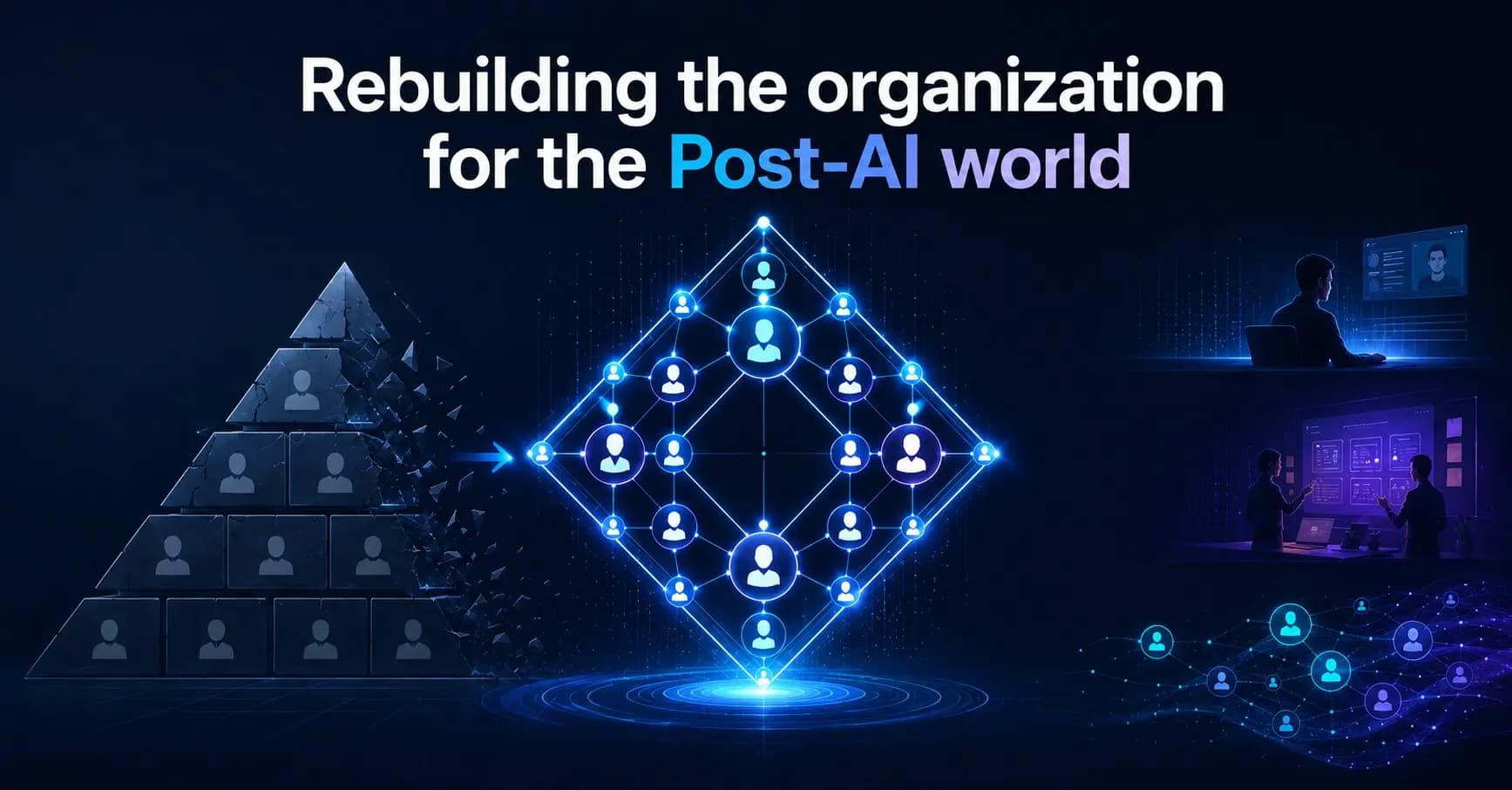
Today, we are a team of over 20 people. But if you looked at our organizational chart, you wouldn't see the traditional pyramid. You'd see a diamond. We didn't set out to reinvent the corporate structure; rather, the technology forced our hand. As we scaled, we realized that the "tried and true" methods of building a tech company are fundamentally broken in the age of AI.
This article explores some of the changes and their impact on our organizational choices.
1. The "Broken Pact" and the Diamond-Shaped Team
In the pre-GenAI era, the "pact" between junior and senior engineers was simple:
- The Junior handled the repetitive, boring, and boilerplate work that seniors didn't want to do.
- The Senior provided coaching and mentorship in exchange for that labor.
That pact is now broken. In a GenAI-native workflow, the boring and repetitive work is being reduced, as AI does it in seconds. This means coaching a junior is no longer a "trade"; it's often a net-negative for a senior engineer because there is no grunt work for the junior to take off their plate.
Consequently, we've moved to a Diamond Shape. We've only hired three juniors since we started. Instead, we over-index on senior and lead engineers who possess the judgment and experience that AI can't replicate. We prioritize "hands-on" leadership where the person leading the team is just as likely to be in the codebase as they are in a client or product meeting.
2. The 1:15 Ratio: Engineering as Project Management
The industry standard used to be roughly one Project Manager (PM) for every five engineers. As engineers become more productive with AI, some argue you need more PMs to manage the increased output. We believe the opposite.
At ArcFusion, we operate with one PM for 15+ engineers. We've achieved this by expanding the role of the engineer. Because AI handles the bulk of the "syntax" and coding labor, our engineers have the mental bandwidth to own the project management and client communication themselves.
We have eliminated the handover cost. There is no "telephone game" where client requirements get lost moving from a PM to a dev. The person building the solution is the person who understands the problem. Strong project management skills are becoming more important for engineers to grow in their role at ArcFusion.
3. Killing the "Slick" Sales Model
Selling GenAI services is about trust and technical proof. I find it relatively easy to generate leads in this space — substantially easier compared to any other commercial role I've found myself in. Developing concrete proposals, however, is substantially more difficult compared to the average sales role.
We've found that classical sales skills are less relevant in this space. Our sales process typically takes the form of a deep-dive engineering exercise. We earmark a significant portion of our engineering time for pre-sales because the main way to win a contract is to:
- Understand the problem statement better than anybody else.
- Build a functional prototype that proves it works.
- Translate technical possibility into a meaningful proposal.
We don't need the usual sales skills — we need consultative engineers who can build as they develop clients.
4. The "Un-Org" Chart: Merit Over Boxes
I've always lived by a simple rule in organizational design: Postpone formal organizational structure as long as possible, but don't wait until it breaks.
Despite being 20+ people, we still don't have a formal "lines and boxes" hierarchy. Instead, we have an informal, highly fluid system based on merit and seniority. Because everyone is hands-on, the hierarchy is felt through expertise, not titles. This also makes the team more frictionless: without rigid silos, we can move people to where the most interesting (and difficult) problems are.
In Conclusion
Our model is a response to a world where the cost of doing — coding, coordinating, selling — is dropping, and the value of thinking — architecting, problem-solving, trust-building — is skyrocketing.
We are building a company to solve problems. And as it turns out, when you hire the right people and give them the right tools, you don't need a lot of boxes to keep them in. I like it this way.